
For owners and CEOs
You gave a number for this quarter. You’re not sure it’s real.
Your team retells every deal twice before it reaches you. RevHeat reads every call, coaches each rep on what the buyer said, and checks the next call, so your number stops being a guess.
One deal in your number, flagged: three calls in, still no date with the buyer.
 Platform Settings
1High risk: with no date booked, this deal can slip out of the quarter.
Deals to watch: Redhawk
Redhawk, last call with Cole. High risk.
Decision maker not engaged: Dwight signs and Cole has never spoken to him.
Why it needs attention: Three calls, three closes on ‘I’ll reach out’ with no dated next step. Call 3 Sam literally asked ‘When?’ and Cole answered with a send date.
What to do: Book a dated working session to shape Sam’s recommendation to Dwight, and get it on the calendar before the call ends.
Sales teams that work with RevHeat












Where your number comes from
Every deal reaches you retold twice. Once by the rep, once by the manager.
Each layer is one more retelling between what the buyer said and the person who owns the number.
- 01RepHears the buyer. Writes down what they think it meant.
- 02ManagerHears the rep. Rolls it into the team’s number.
- 03YouHear the manager. Give the number.
That’s not your manager’s fault. It’s arithmetic. They can’t be on every call.
Trimming on instinct cuts the wrong deal. The buyer already told you which one.
Cut the wrong deal and you plan hiring and cash around a number that was never there.
“95% of our pipeline wasn’t real.”
Today he calls it qualified and predictable.
Results from the RevHeat Sales Methodology and Coaching.
 Brad Garber · COO, Hidden LevelRevHeat client
Hidden Level: 1,500%+ bookings growth · $3M to $50M+ in two years
One deal in your number
Your rep says it’s closing. The buyer never did. Here’s what the calls show.
Redhawk: about $39,000, three calls in. Cole is the rep. Sam is the buyer. Dwight signs.
Why it might not close, from what the buyer said.
What could stop this deal (3)
No date for the next meeting
Three calls, three closes on ‘I’ll reach out’ with no dated next step.
The person who signs isn’t in the deal
Dwight signs and Cole has never spoken to him.
The buyer’s own reason is missing
Cole has the stores’ reason to buy ($51K sourcing, Bakersfield, write-offs) but not Sam’s reason.
What moves it: the next step, and the words Cole can use.
Book a dated working session to shape Sam’s recommendation to Dwight — offer two times after a contractor Tuesday, and get it on the calendar before you hang up.
“Sam, last time you asked ‘when?’ and I gave you a send date — that was me dodging. Before we get into the pricing and the security packet, I want to put a specific time on the calendar for us to build what you walk into Dwight’s office with. Does the Thursday after next Tuesday’s contractor visit work, or the Friday?”
What they said it’s worth
“And the price is still thirty-nine.”
Sam, the buyer · call 3
Redhawk isn’t real yet: the person who signs hasn’t been on a call.
The buyer is talking price, but there’s no date with Dwight. That one move decides whether this deal belongs in your number.
Ask RevHeat
Ask who signs before you count a deal. The answer comes from the calls.
Your question about Redhawk, and the answer, with timestamps.
Who actually makes the decision on Redhawk?
Based on what’s in the transcripts, it’s a two-person dynamic rather than a single decision-maker:
Dwight is the formal signer. Sam told Cole on call 3 that Dwight is the owner (19:20–19:23), and that “anything over about twenty-five he signs” (19:27–19:33) — meaning a roughly $39,000 proposal would clearly require Dwight’s sign-off.
Sam is the one who builds the case and likely drives the recommendation. When Cole asked on call 3 whether Dwight is someone he should talk to directly, Sam said “He’d want me to have an opinion first” (19:56–20:01) — implying Sam vets and forms a recommendation before it goes to Dwight, rather than Cole pitching Dwight directly. This lines up with something Sam said back on call 1, when asked what would make the deal happen this year: “Somebody above me deciding it matters” (25:19–25:24), suggesting Sam sees the final call as sitting above his own authority.
Sam also told Cole what Dwight cares about: “that we’re not writing off inventory” and “that I’m not asking him for something every quarter” (19:38–19:49) — so whatever case gets made to Dwight will likely need to speak to inventory write-offs and operational independence, not just the sourcing-cost number.
So: Dwight holds the actual signature authority above roughly $25k, but Sam is positioned as the one who has to be convinced first and will carry the recommendation to him. Nothing in the transcripts indicates Cole has spoken with Dwight directly or is likely to get to do so before Sam forms his own opinion.
Transcripts consulted
Redhawk — discovery call, 1 of 3 · Transcript Redhawk — discovery call, 2 of 3 · Transcript Redhawk — discovery call, 3 of 3 · Transcript- Only calls linked to this deal and accessible to you are available. A shared deal label does not prove all calls concern one transaction.
- Transcript statements are evidence of what was said, not independently verified facts.
- Unread portions cannot support absence claims.
What changed between the first call and the third call, and what should Cole do on the next one?
Comparing call 1 with call 3 shows a real shift in how Cole ran the meeting, not just in tone.
Call 1
Cole opened by sharing his screen almost immediately (0:27) and ran a product walkthrough from 0:34 to 13:20 — dashboard, scheduler, variance board, picker app, escalation rules, reporting, permissions — before asking Sam anything about Redhawk’s actual situation. Sam’s participation during that stretch was three short clarifying questions (4:52, 8:40, 11:05). When Cole finished, Sam’s reaction was blunt: “I mean, it looks like software” (13:31), and he noted he’d “sat through three of these this year” (13:38).
Pricing came up as a vague range — “in the neighborhood of forty… it moves a little depending on modules” (18:52–19:08) — and Cole offered an unverified savings claim (“typically… that goes away pretty quickly,” 19:22) that Sam pushed back on flatly: “Typically.” (19:33). Sam also raised a security/vendor review requirement (24:10–24:38), which Cole acknowledged but didn’t follow up on substantively — he called it “never… the thing that holds a deal up” (24:50) and moved on. The call ended soft: Sam said it was “interesting” but not clearly “this year” (25:08), and the only firm ask was “send me a proposal” (28:36).
Call 3
Cole explicitly named the change at the start: “I’m not going to walk the product… I spent twenty minutes last call on things that weren’t it” (0:00–0:18). He opened by asking Sam to walk through a real week at Bakersfield (0:21), which surfaced concrete facts: counts happening “maybe one Wednesday in four” (0:44), and a hard cost figure Sam hadn’t quantified before — “about fifty-one thousand last year across the six” in emergency sourcing (1:52–2:14).
Only after that number did Cole share his screen, and for six minutes, not thirteen-plus (2:17–2:33, confirmed “two screens” at 2:29). What he showed was built around what Sam had just said — a scheduler configured for Bakersfield’s one-counter, twenty-hour shape, and a report tying sourcing spend to count compliance, which Cole offered as an explicit test: “if your fifty-one doesn’t move in two quarters, the thing isn’t working” (9:32–9:49).
Cole also went back and closed two threads he’d dropped earlier — the Epicor integration question (10:09–10:38) and the security review Sam had raised on call 1 (20:14–20:40) — giving real detail (two integration paths, contractor time estimates) rather than reassurance. The call ended with Sam saying “it was more useful than the last one” (27:44–27:50).
What should happen on the next call
- Bring the three deliverables Cole promised, with firm numbers. He committed to two-store (Bakersfield + Fresno) pricing, Epicor connector scope, and the security packet by “end of next week” (20:53–21:01). The next call needs to open with those delivered, not discussed in the abstract — the credibility gained on call 3 depends on not reverting to the softness of the first call’s “neighborhood of forty.”
- Keep leading with Sam’s facts, not the product. The pattern that worked was asking before showing. The next call should likely start by checking what Sam learned from his contractor about the two-week connector timeline (11:08) and whatever Dwight’s reaction has been, rather than opening with screen share.
- Hold the accountability test he set himself. Cole proposed measuring sourcing spend against count compliance over two quarters. The next call should include how that would actually be tracked for Bakersfield and Fresno — not just pricing and scope.
- Give Sam material built for Dwight, not just verbal numbers. Sam was clear Dwight signs anything over ~$25,000 and wants Sam to “have an opinion first” (19:27–19:56). Whatever Cole brings should be something Sam can hand off or present, since Cole won’t be talking to Dwight directly.
- Follow up on the two stores still missing numbers. The call ended with Sam describing the Bakersfield acquisition and Cole asking about the other two stores without sourcing figures (27:14–27:40); the transcript doesn’t capture Sam’s answer, so that’s a loose thread to pick back up rather than let drop.
In short: the first call was Cole running his deck; the third call was Cole running Sam’s problem. The next call needs to prove that wasn’t a one-time correction — deliver on time, with real figures, and keep opening with Sam’s situation rather than the product.
The number you answer for
You’ll hire against this number. Is it real? Check it against what buyers said.
When you’re the one who has to answer for the number, your commit comes from what buyers said on the calls. Not from what each manager thinks.
Your managers’ forecast calls change too.
Each deal gets talked through on what the buyer said.
Across your whole number
Which deal will surprise you this quarter? It’s already at the top of this list.
Each one gets the same read as Redhawk: what could stop it, and the move that changes it.
Your team, deal by deal.
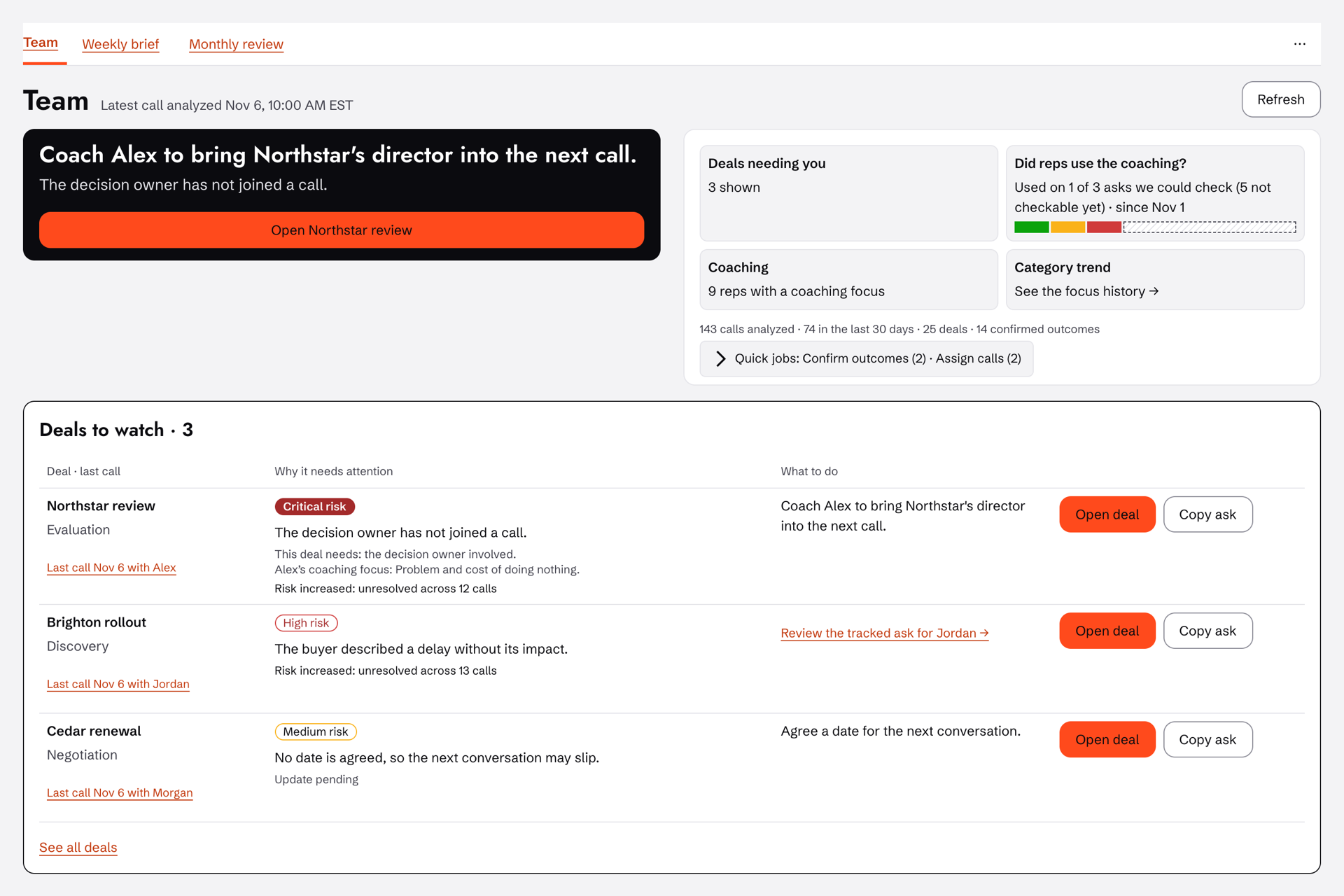
1Top of the list: Northstar, critical. The person who decides hasn’t joined a call.
Talk it through with us
Stop bracing for the forecast call. Give a number you can trust, every quarter.
On a 25-minute call, we’ll look at how your forecast gets built today, and what changes when someone reads every call and coaches every rep.
You ask, we answer, and you decide what comes next.






and many others
Will this replace my recorder? Keep the call recorder you have. If you don’t have one, we’ll recommend one.